Native Engineering – Different Types of Foundations Used in Construction
When it comes to building any structure—whether it’s a small house, a skyscraper, or a bridge—the foundation is one of the most crucial elements. It’s the part of the structure that transfers the load of the building to the ground and ensures stability, safety, and durability. Choosing the right type of foundation depends on factors such as soil condition, load of the structure, groundwater level, and budget.
In this blog, we’ll explore the different types of foundations used in construction, their characteristics, and how native engineering solutions still influence modern foundation practices.
1. Shallow Foundations
Shallow foundations are used when the load of the structure is relatively low and the soil near the surface has adequate bearing capacity. These foundations transfer loads to the earth at a depth less than or equal to the width of the foundation.
a. Isolated Footing (Pad Footing)
Supports a single column and distributes the load safely to the soil. Typically square, rectangular, or circular.
Used for: Light to moderate loads (e.g., residential buildings).
Advantages: Simple design, economical, and easy to construct.
b. Combined Footing
When two or more columns are close enough that their individual footings would overlap, a combined footing is used. It evenly distributes the loads of both columns.
Used for: Columns near property boundaries or with unequal loads.
Advantages: Efficient use of space and uniform load transfer.
c. Strap (Cantilever) Footing
Connects two isolated footings with a strap beam, balancing moments and distributing loads evenly.
Used for: Structures near property lines.
Advantages: Reduces differential settlement, cost-effective solution.
d. Raft (Mat) Foundation
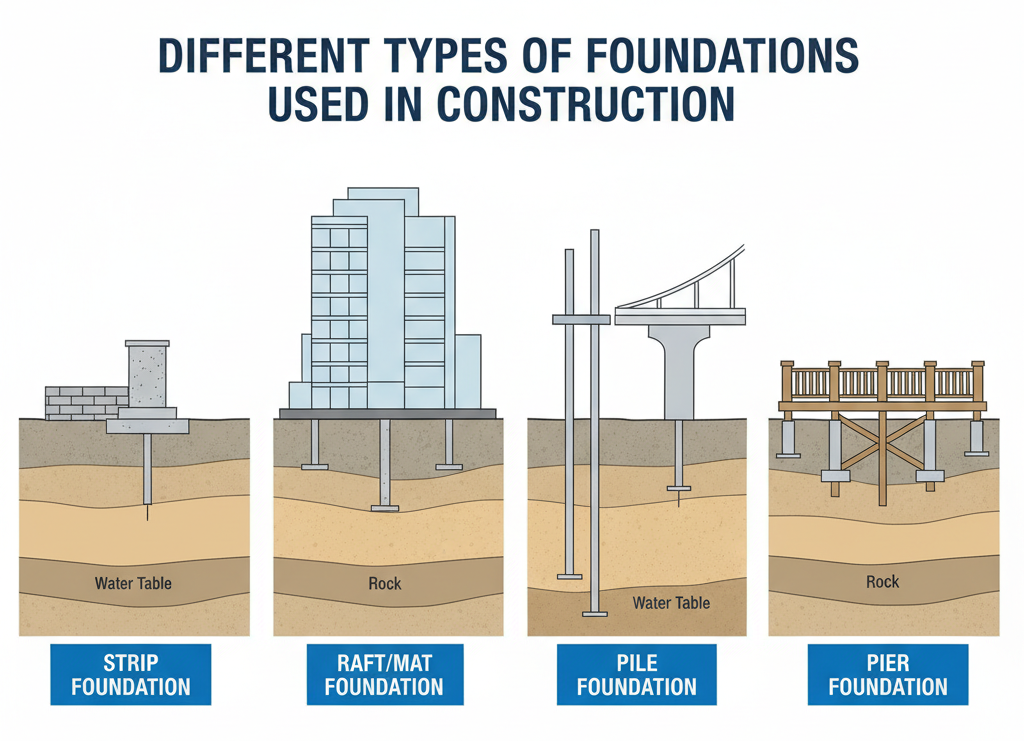
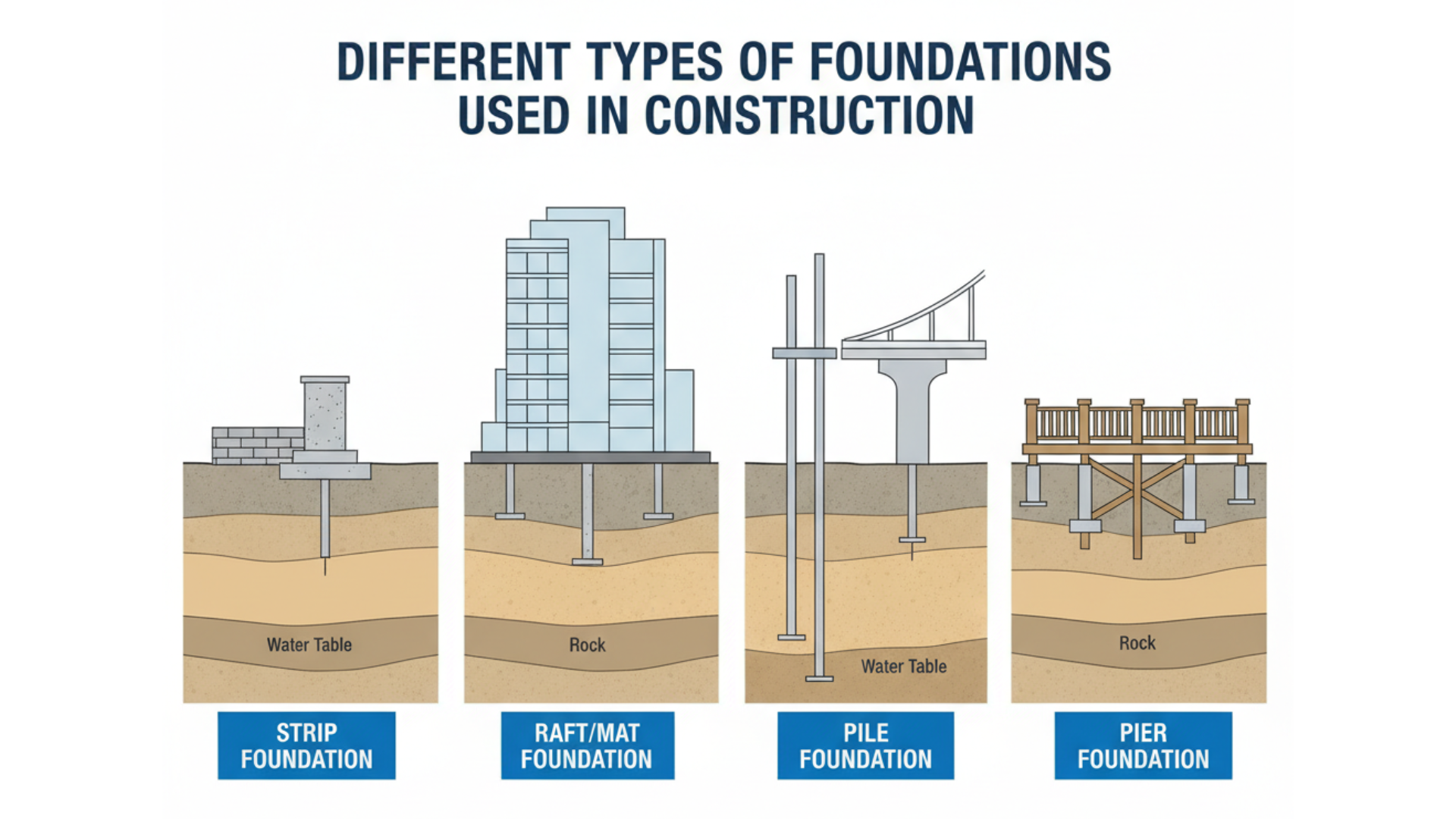
A large slab supporting several columns and walls, spreading the load over a wide area—ideal for poor soil conditions.
Used for: High-rise or industrial buildings.
Advantages: Minimizes soil stress, ensures uniform settlement.
2. Deep Foundations
Deep foundations are required when the surface soil cannot support the structure’s load. They transfer loads to deeper, stronger soil or rock layers.
a. Pile Foundation
Long, slender columns made of steel, concrete, or timber driven deep into the ground. They handle both vertical and horizontal loads.
Used for: Bridges, high-rise structures, weak or waterlogged soils.
Advantages: Supports heavy loads, ideal for deep or soft soils.
b. Pier Foundation
Cylindrical columns that transfer loads to firm strata, often used in dry areas.
Used for: Bridges and elevated structures.
Advantages: Easy to inspect and economical for moderate depths.
c. Caisson (Well) Foundation
Watertight retaining structures used underwater or in deep strata, often sunk into riverbeds.
Used for: Bridge piers, docks, marine works.
Advantages: Extremely stable and durable.
3. Native Engineering Solutions (Traditional Foundation Practices)
Before modern engineering and concrete technology, local builders relied on native engineering solutions—foundation systems designed using locally available materials and indigenous knowledge suited to their environment.
Here are some notable traditional practices:
a. Rubble Stone Foundations
Used widely in rural and hilly regions, rubble foundations involve layers of undressed stones placed in trenches and compacted with smaller stones or lime mortar.
Used for: Small houses, temples, and retaining walls.
Advantages: Low cost, good drainage, environmentally friendly.
b. Bamboo and Timber Foundations
In flood-prone and coastal regions (like parts of Assam or Southeast Asia), bamboo or timber piles were driven into soft soil to form a grid foundation for light structures.
Used for: Stilt houses and huts in wetlands.
Advantages: Flexible, lightweight, sustainable, and easy to repair.
c. Mud and Lime Stabilized Foundations
In dry or semi-arid zones, builders used compacted mud mixed with lime or jaggery (traditional stabilizers) to increase strength and water resistance.
Used for: Traditional earthen or adobe houses.
Advantages: Cost-effective, thermally efficient, and eco-friendly.
d. Laterite Block Foundations
Common in tropical regions (like South India and Africa), laterite stone blocks were used as foundation materials due to their strength and local availability.
Used for: Traditional houses and small masonry structures.
Advantages: Naturally strong, breathable, and durable.
e. Stone Trench Foundations
In mountainous areas, builders excavated trenches filled with large stones to distribute loads evenly and prevent sliding on slopes.
Used for: Hill structures and mountain villages.
Advantages: Excellent for sloping terrain and seismic zones.
4. Factors Affecting the Choice of Foundation
The selection of a foundation type—modern or traditional—depends on:
Type of structure (residential, industrial, commercial)
Soil bearing capacity
Groundwater level
Environmental and seismic conditions
Budget and available materials
Cultural or regional building practices
Conclusion
From high-tech pile foundations to traditional rubble and bamboo bases, the choice of foundation reflects both engineering principles and local wisdom. While modern techniques emphasize precision and load management, native engineering solutions remind us of sustainable, context-sensitive construction practices that stood the test of time.
Integrating both approaches—modern design with traditional insight—can lead to foundations that are strong, affordable, and environmentally responsible.